
Diamond Wedding Rings
Browse diamond wedding rings and wedding bands from featured online jewelry merchants.

Browse diamond wedding rings and wedding bands from featured online jewelry merchants.
Explore diamond wedding rings and wedding bands from Angara.
Browse diamond wedding rings and wedding bands from Auralume.
Explore diamond wedding ring and wedding band designs from DazzlingRock.
Browse diamond wedding ring and wedding band selections from Gelbesty.
Browse diamond wedding ring and wedding band selections from Houston Diamond District.
Browse diamond wedding ring and wedding band selections from IMOLOVE.
Explore diamond wedding rings and wedding bands from Jewels by Lux.
Browse diamond wedding rings and wedding bands from Kobelli.
Browse diamond wedding rings and wedding bands from Ross-Simons.
Explore diamond wedding ring and wedding band selections from Roy Rose Jewelry.
Browse diamond wedding rings and wedding bands from THELANDA.
Explore diamond wedding rings and wedding bands from Vir Jewels.
Affiliate Disclosure: DiamondAvenue.com may earn a commission from qualifying purchases made through affiliate links at no additional cost to you.
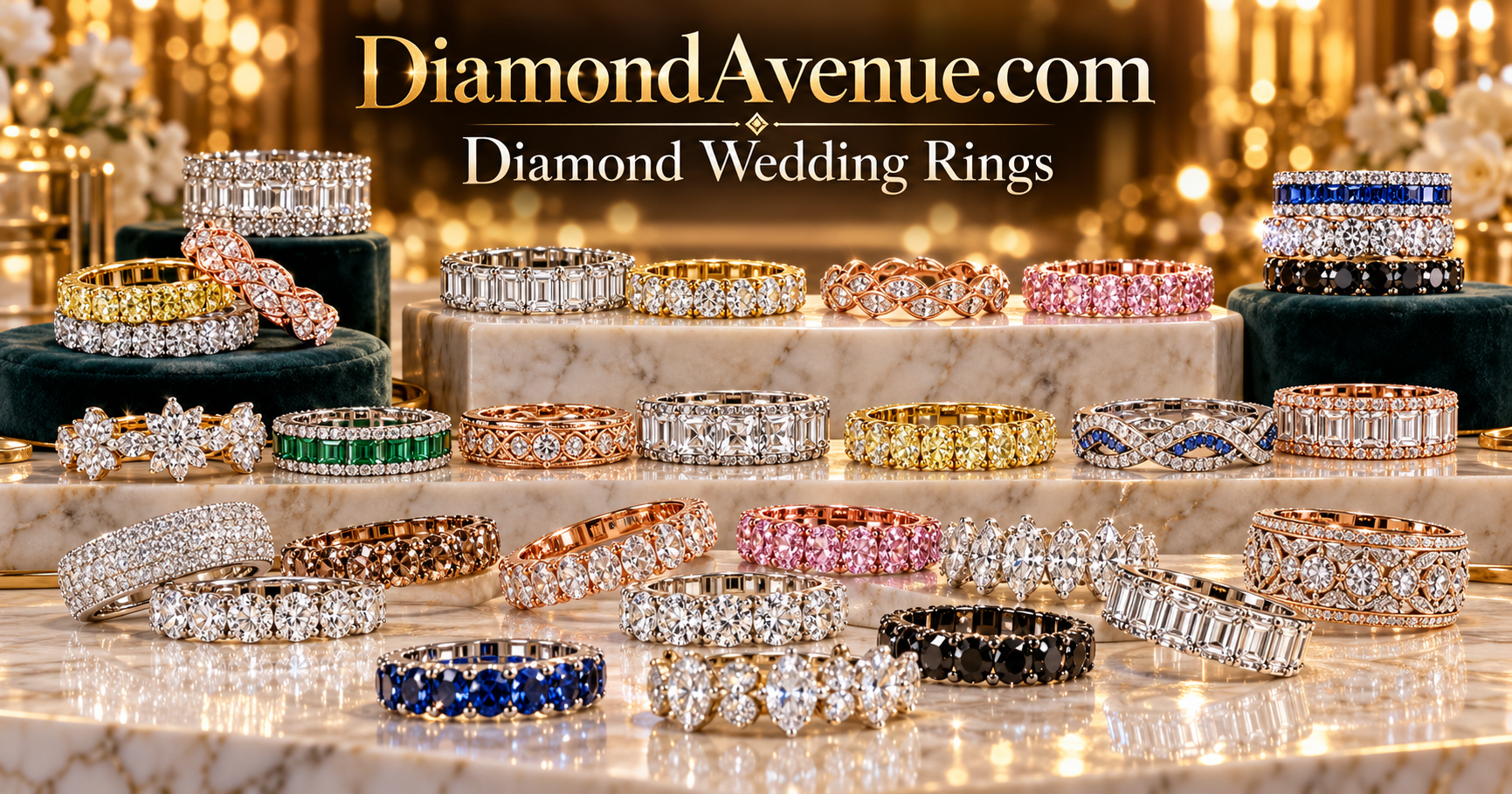
Diamond wedding rings and bands symbolize love, commitment and the promise of a lasting relationship. Unlike many other pieces of jewelry, a wedding ring is often worn every day for decades, making its appearance, comfort, durability and workmanship especially important.
Diamond wedding bands range from traditional gold or platinum rings accented with a few diamonds to elaborate eternity bands containing diamonds around the entire circumference. Other designs feature pave settings, channel-set diamonds, multiple rows of gemstones or decorative metalwork.
Choosing a diamond wedding ring involves more than selecting a beautiful design. Diamond quality, carat weight, precious metal, ring width, sizing, setting security and compatibility with an engagement ring can all affect the final choice.
This DiamondAvenue.com buying guide explains the major considerations that can help buyers compare diamond wedding rings and select a band that combines lasting beauty with practical everyday wear.
Diamond wedding rings are available in numerous styles, ranging from understated traditional bands to luxurious rings featuring diamonds across much of their surface. The choice depends on personal taste, lifestyle, budget and whether the band will be worn alone or beside an engagement ring.
Classic diamond wedding bands often feature a simple gold or platinum design accented with one or more carefully placed diamonds.
These rings offer a balance between traditional wedding-band styling and the brilliance of diamonds. They can be especially suitable for everyday wear and for pairing with engagement rings.
Half-eternity bands feature diamonds across approximately half of the ring's circumference, although coverage varies by design.
Because diamonds are concentrated on the visible upper portion, these rings can offer substantial sparkle while retaining an undecorated section that may allow for easier sizing adjustments.
Full-eternity bands feature diamonds extending around the entire circumference of the ring.
They symbolize never-ending love and provide sparkle from every viewing angle.
However, full-eternity rings can be difficult or impractical to resize, and diamonds on the underside may be exposed to additional wear.
An eternity ring symbolizes continuous love through a repeating arrangement of diamonds.
Although full-eternity rings traditionally contain diamonds around the complete circumference, the term is also commonly used for partial-eternity designs.
Eternity bands may contain round, princess, emerald, oval or other diamond shapes.
Learn more about diamond eternity rings and bands.
Diamond anniversary bands are often given to celebrate important wedding anniversaries, although similar designs may also be selected as wedding rings.
They frequently feature a row of diamonds across the upper half or upper portion of the band.
Anniversary rings can be worn alone, beside a wedding ring or stacked with other meaningful jewelry.
The distinction between a wedding band and an anniversary band often depends on how the ring is purchased and worn rather than on a specific structural design.
The setting determines how diamonds are secured in the ring and influences their visibility, protection, sparkle and maintenance requirements.
Different settings also affect the ring's overall profile and how comfortably it fits beside an engagement ring or other bands.
Prong settings use small metal supports to secure each diamond.
They expose much of the diamond and can create a brilliant, open appearance.
Prongs should be smooth, properly aligned and securely constructed. They should also be inspected periodically for wear or looseness.
Pave settings use numerous small diamonds set closely together, creating a surface that appears to be covered with sparkle.
Pave wedding bands may contain one or several rows of diamonds.
Because the settings are relatively delicate, the workmanship and security of the small diamonds deserve careful attention.
Channel settings hold a row of diamonds between two continuous walls of precious metal.
This can create a smooth, streamlined appearance and provide some protection for diamond edges.
Channel-set rings are often chosen for their contemporary appearance and relatively low-profile design.
A bezel setting surrounds all or part of a diamond's edge with precious metal.
The metal rim can help protect vulnerable edges and reduce the likelihood of the diamond catching on clothing or other objects.
Bezel-set wedding bands often have a smooth, modern appearance and may be practical for frequent wear.
Some wedding rings feature two or more rows of diamonds arranged across a wider band.
These designs can create a dramatic appearance and substantial visible sparkle.
However, wider rings may feel heavier or less flexible on the finger, making comfort and accurate sizing particularly important.
The diamond shapes selected for a wedding band affect its sparkle, appearance and overall style.
Round brilliant diamonds are common because they offer strong potential for brilliance and work well with many settings.
Princess-cut diamonds provide a more geometric appearance, while emerald and baguette cuts create distinctive rows of broad, step-cut facets.
Oval, cushion, radiant and other shapes may also be used in eternity and anniversary bands.
For a detailed comparison, visit the Diamond Shapes Guide.
Diamonds used in wedding rings are evaluated using the same Four Cs that apply to diamonds used in engagement rings and other jewelry.
These characteristics influence appearance, rarity and price.
However, wedding bands often contain numerous small diamonds rather than one large center diamond.
For this reason, consistent matching and overall workmanship can be particularly important when evaluating a diamond wedding ring.
The best choice usually involves balancing all four characteristics.
Diamond cut has an important influence on brightness, fire and scintillation.
A well-cut diamond can appear lively and brilliant even at a relatively modest size.
In wedding bands containing multiple diamonds, poorly matched cut quality may cause some stones to appear noticeably brighter than others.
Diamonds in the same wedding ring should generally complement one another in:
Consistent matching contributes to a balanced, attractive finished ring.
Diamonds in the traditional D-to-Z grading range are evaluated according to the amount of visible yellow or brown body color.
When numerous diamonds are mounted side by side, significant differences in color may become more noticeable.
For a uniform-looking band, buyers should look for diamonds with reasonably consistent face-up color.
Clarity refers to inclusions within a diamond and blemishes on its surface.
Small diamonds in wedding bands may not require exceptionally high clarity grades to appear attractive to the unaided eye.
However, noticeable inclusions, fractures or other durability-related characteristics should be evaluated carefully.
Diamond wedding bands are frequently advertised according to their total carat weight.
Total carat weight refers to the combined weight of all diamonds included in the ring, rather than the weight of any individual stone.
For example, a wedding band containing ten diamonds weighing approximately 0.10 carat each has a total diamond weight of approximately one carat.
Always review both the total carat weight and the size and number of diamonds.
Diamond carat weight measures mass, not the physical dimensions of the ring.
Two wedding bands containing the same total carat weight may look very different.
One ring may contain a few larger diamonds, while another uses numerous smaller stones.
Ring width, diamond diameter, setting design and spacing can all influence the final visual appearance.
A diamond wedding band is often worn beside an engagement ring, making compatibility an important consideration.
The two rings do not necessarily need to have identical designs, but they should look balanced and fit together comfortably.
When comparing rings, consider:
Some engagement ring settings require contoured or specially designed wedding bands to fit closely around the center setting.
Explore Diamond Engagement Rings for additional design considerations.
Straight bands have a traditional, uniform circular design.
They can be especially versatile because they may be worn alone or paired with different rings.
However, some engagement ring settings prevent a straight band from sitting directly against the engagement ring.
Contoured bands have a curved or shaped outline designed to fit around portions of an engagement ring.
They are often selected when the engagement ring has a low-set center diamond or an unusual setting profile.
Before purchasing, verify that the contour matches the engagement ring closely.
The precious metal used in a wedding ring affects its appearance, durability, weight, price and maintenance requirements.
Popular choices include platinum, yellow gold, white gold and rose gold.
Platinum is a naturally white, dense precious metal valued for its durability and suitability for fine jewelry.
It does not require rhodium plating to maintain its natural white color.
White gold combines gold with other metals to create a light-colored alloy.
Many white-gold rings are rhodium-plated to produce a brighter white finish.
Yellow gold has a warm, traditional appearance and complements a wide variety of diamond settings.
It is often selected for classic and vintage-inspired wedding bands.
Rose gold obtains its pinkish color primarily from copper-containing alloys.
It can create a warm, distinctive appearance in both modern and romantic wedding ring designs.
Fourteen-karat gold contains approximately 58.3 percent pure gold, with the remainder consisting of alloying metals.
It is popular for wedding rings because it offers a practical balance between gold content, durability and cost.
Eighteen-karat gold contains 75 percent pure gold.
Its higher gold content may provide a richer color, particularly in yellow and rose gold designs.
The choice between 14K and 18K gold should consider durability, appearance, alloy composition and budget.
Accurate sizing is particularly important for wedding rings because they are frequently worn every day.
Finger size can fluctuate with temperature, activity and other conditions.
A ring should fit securely while still being comfortable to remove.
Professional measurement is especially recommended before ordering a valuable diamond wedding ring.
Some diamond wedding bands can be resized, while others are difficult or impossible to resize without substantial alteration.
Bands containing diamonds around the entire circumference are particularly challenging.
Before purchasing, ask whether the ring can be resized and what adjustments the seller permits.
Wedding bands are available in a variety of widths, from narrow delicate designs to substantial wide bands.
Wider rings may feel tighter or less flexible than narrower bands of the same nominal size.
A comfort-fit interior, featuring a gently rounded inner surface, can make some rings more comfortable during extended wear.
Wedding rings encounter regular contact with desks, door handles, tools and other everyday surfaces.
The design should be appropriate for the wearer's daily activities.
Low-profile settings and securely mounted diamonds may be preferable for people who frequently work with their hands.
Remove fine jewelry when performing activities that could damage the ring or expose it to hazardous machinery.
Men's diamond wedding rings are available in both traditional and contemporary designs.
Some contain a single diamond set flush into the band, while others feature several diamonds arranged in rows, channels or geometric patterns.
Popular choices include wider gold or platinum bands with understated diamond accents.
As with all wedding rings, comfort, ring width, setting security and durability should be considered alongside appearance.
Natural diamonds form within the Earth under geological conditions of high pressure and temperature.
They are mined, cut and polished before being mounted in jewelry.
When purchasing a natural diamond wedding ring, review the seller's disclosures and available grading information.
Lab-grown diamonds are real diamonds produced in controlled technological environments.
They have essentially the same chemical composition and crystal structure as natural diamonds.
Their different origin affects pricing and market considerations.
Buyers should confirm whether the diamonds are natural or laboratory-grown.
Diamond wedding rings do not have to contain only colorless diamonds.
Fancy-color diamonds can introduce yellow, pink, blue, brown and other colors into a wedding band.
Some rings alternate colored diamonds with colorless stones, while others use a continuous row of matching fancy-color diamonds.
Color origin, intensity, treatments and matching should be carefully reviewed when selecting these designs.
Explore Fancy Colored Diamonds for additional information.
Stackable wedding bands are designed to be worn together with other rings.
They can combine different diamond shapes, metals, textures and widths to create a personalized appearance.
When stacking rings, consider how their surfaces contact one another and whether the settings could cause excessive rubbing or wear.
Wedding bands do not necessarily need to match the exact metal color of an engagement ring.
Combining yellow, white and rose gold can create a distinctive modern appearance.
However, rings worn together should be evaluated for differences in hardness, construction and possible wear where the surfaces touch.
Larger diamonds may be accompanied by independent grading reports describing their characteristics.
Wedding bands containing many small diamonds are not always accompanied by individual grading reports for every stone.
In those cases, buyers should carefully review the seller's description of the diamonds, including total carat weight, color, clarity and origin.
A jewelry appraisal generally provides a valuation for a specified purpose, such as insurance.
A grading report describes gemological characteristics and does not serve the same purpose as an appraisal.
Higher-value wedding rings may warrant appropriate jewelry insurance.
Online jewelry merchants may offer a broad selection of diamond wedding rings, making it convenient to compare styles, specifications and prices.
However, a wedding ring should never be evaluated by photographs and total carat weight alone.
Before purchasing, carefully review the product specifications, seller policies and available documentation.
Review the merchant's reputation, customer service information and product descriptions.
Determine whether warranties, independent grading reports, appraisals or other documentation are provided where appropriate.
Make sure any diamond treatments are properly disclosed.
Always review the seller's return and exchange policies before ordering a wedding ring.
Determine whether returns are permitted for incorrect sizing, custom designs or engraved rings.
Some custom or specially ordered wedding bands may have restricted return privileges.
Diamond wedding bands are available across a broad range of prices.
The final cost depends on factors including precious metal, diamond quantity, total carat weight, diamond quality, design complexity and workmanship.
A larger total carat weight does not automatically make one ring more attractive or desirable than another.
The goal should be to select a well-made ring that provides lasting satisfaction without exceeding a comfortable budget.
Skin oils, lotions, cosmetics, soap residue and everyday dirt can collect around diamond settings.
Regular appropriate cleaning helps maintain diamond brilliance and the appearance of the metal.
Follow cleaning recommendations suitable for the ring's materials, construction and any treatments.
Avoid aggressive cleaning methods that could damage delicate settings or treated gemstones.
Wedding bands containing numerous diamonds should be inspected periodically for loose stones and worn settings.
Prongs, channels and other metal supports can wear over time.
If a diamond appears loose, discontinue wearing the ring until it has been examined by a qualified jeweler.
Learn more in the Diamond Care Guide.
Before selecting a diamond wedding ring, consider the following questions:
A diamond wedding ring is more than a decorative piece of jewelry. It represents a lasting commitment and may become one of the most frequently worn possessions a person owns.
The best wedding ring combines an appealing design with appropriately selected diamonds, secure settings, comfortable proportions and quality workmanship.
Whether choosing a traditional diamond band, a half-eternity ring, a full-eternity design or a contemporary multi-row wedding ring, careful comparison can help ensure that the final selection remains attractive, comfortable and meaningful for years to come.
The Four Cs | Carat Weight | Clarity | Color | Cut | Diamond Shape
Eternity Rings | Engagement Rings | Lab-Created Diamonds | Diamond Care